Showing posts with label Brewing. Show all posts

Sunday, July 31, 2011

Pale Ales — Walkabout Brewing vs. Seven Brides Brewing


Walkabout Brewing Co.
Worker's Pale Ale

ABV 5.5%

Color: Crystal clear orange.
Aroma: Spicy hops, roasty malts and a bit of dank funkiness.
Flavor: Clean with mildly bitter citrus hops and herbal notes.
Hops vs. Malts
(Hoppy, Malty or Balanced):
Hoppy
Finish: Mild bitterness turning to moderate bitterness.
Overall (Fantastic, Good, Mediocre or Bad): Good


Seven Brides Brewing Co.
Lauren's Pale Ale
ABV 5.7%

Color:
Cloudy orange. 
Aroma: Floral and perfumy with tropical fruit notes. Alcohol is also noticeable. Kind of like a fruit brandy.
Flavor: Tart. Almost like a hard cider with a bit of lemon squeezed in.
Hops vs. Malts (Hoppy, Malty or Balanced): N/A (tart and sour)
Finish: Harsh lemon rind bitterness.
Overall (Fantastic, Good, Mediocre or Bad): Bad

Blow by Blow 
Another day in the low 90s down here in Southern Oregon had us craving some refreshing pale ales. Fortunately many craft breweries make a pale ale as it is usually a gateway beer to get people hooked on hops. After featuring a brewery from the midwest in last week's battle we decided to keep it closer to home for this one with two breweries from Oregon, one close to us in Central Point (Walkabout) and one near Salem in Silverton (Seven Brides).

Unfortunately it was a lopsided fight. So lopsided, in fact, that we suspect foul play. And by foul we mean that the Seven Brides seemed tainted. It had an intriguing aroma with tropical fruit and alcohol notes, but the flavor was so tart that we would have guessed it was a mild sour beer. We're pretty sure that Seven Brides did not intend to make their Pale Ale sour, so either it was improperly stored, spent too much time on the shelf or the batch was bad. So that was a bummer. We never like to dump a beer down the drain, but we had no choice with the Lauren's Pale Ale.

So the winner by default was the Worker's Pale Ale. It's a classic northwest pale ale with plenty of citrus hops to round out the roasty malts and even has a bit of funkiness thrown in for good measure. Walkabout is a pretty small brewery, so we're not sure how much distribution it gets outside of the Rogue Valley, but if you see it on tap or in a store it's worth checking out. They have quite a loyal following down here in southern Oregon and we hear that they are in the process of getting a tasting room up and running so we look forward to visiting that in the future.

Winner by unanimous decision: Walkabout Brewing.

Monday, June 13, 2011

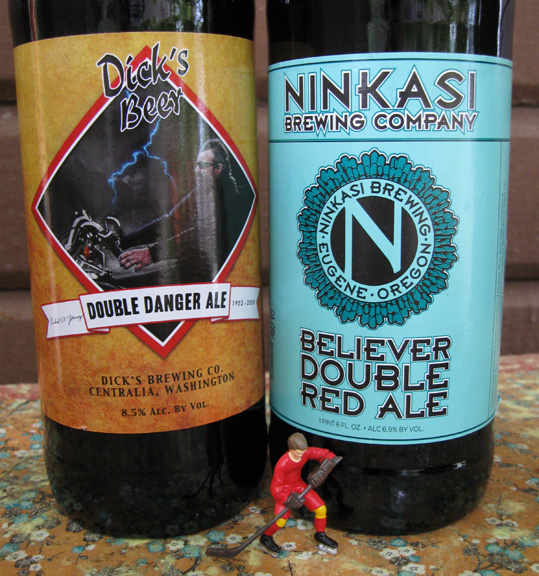
Beers with Double in the Name — Dick's Brewing Co. vs. Ninkasi Brewing Co.


Dick's Brewing Co.
Double Danger Ale

ABV 8.5%

Color:
Cola.
Aroma:
Sweet with coffee and molasses notes.
Flavor:
Smoke and cocoa with clean, berry sweetness.
Hops vs. Malts
(Hoppy, Malty or Balanced):
Malty
Finish: Sweet cocoa.
Overall (Fantastic, Good, Mediocre or Bad):
Good

Ninkasi Brewing Co.
Believer Double Red Ale
ABV 6.9%

Color:
Reddish brown.
Aroma: Dusty malts dominate with some piny hops in the background.
Flavor: Smooth, sweet, cedary maltiness with mellow piny hops.
Hops vs. Malts (Hoppy, Malty or Balanced): Hoppy
Finish: Solid lingering citrus peel bitterness.
Overall (Fantastic, Good, Mediocre or Bad): Good

Blow by Blow
Well, I picked up the Ninkasi Double Red because I thought we had the Dick's Imperial Red waiting at home. Turns out we'd already drunk the Dick's red, but we did have a bottle of the Double Danger that's been itching for a fight. Two beers with "double" in the name? Sure it's a stretch, but a battle is a battle — some are organized and planned, others are the result of circumstance.

As usual, Ellen poured the beer blind for me but it was kind of pointless once I saw the beers. Having tried the regular Dick's Danger Ale many times before, I knew that it was a darker beer, so it was no surprise that the Double Danger fell into that category. The color of the Ninkasi was true to it's name, showing off some nice red accents.

In the aroma and flavor category it became clear that these beers were bizarrely matched. The Ninkasi was a very good double red ale with a smooth, malty base and just enough piny hops and citrus bitterness in the finish to balance it out nicely. It still came across as more of a hoppy beer, but that is what we are always hoping for when we get a "red" ale in the northwest. The Double Danger was also quite good, but in a completely different way. It had almost no hop profile at all, instead offering smoke, cocoa, molasses and a distinct berry sweetness that was well integrated.

We ended up choosing the Ninkasi because it fit our mood and paired better with our dinner, but we'd advise you to buy both. Drink the Believer with some grilled meat (or grilled mushrooms for you non-carnivores) and save the Double Danger for an after dinner treat.

Winner by unanimous decision: Ninkasi Believer Double Red Ale

Monday, June 6, 2011

Anniversary Beers — Shmaltz Brewing Co. vs. Widmer Brothers Brewing Co.


Shmaltz Brewing Co.
Jewbelation Fourteen
14th Anniversary Ale
ABV 14%

Color:
Midnight brown.
Aroma:
Sweet, smoky and boozy with some floral hops mixed in.
Flavor:
Rich, thick, smoky, and super sweet with some soy sauce notes.
Hops vs. Malts
(Hoppy, Malty or Balanced):
Malty
Finish: More smoke and soy sauce
Overall (Fantastic, Good, Mediocre or Bad):
Good -

Widmer Brothers Brewing Co.
84/09 Double Alt
25th Anniversary
ABV 9.8%

Color:
Dark reddish brown.
Aroma: Sweet malts, cocoa and molasses.
Flavor: Sweet rich and malty. Molasses and burnt sugar.
Hops vs. Malts (Hoppy, Malty or Balanced): Malty
Finish: Lingering cocoa with touch of bitterness as well.
Overall (Fantastic, Good, Mediocre or Bad): Good

Blow by Blow

Celebrating an anniversary with an extreme or unique beer has become a tradition of many craft breweries. Drinking these beers has become a tradition of ours.


This battle featured a two year old bottle of Widmer Brothers 25th Anniversary 84/09 that I picked up recently at the new bottle store in Lynnwood, Special Brews. They had a real nice selection of beers and I noticed a few other aged beers as well. Apparently they also have six taps up and pouring now, so they're definitely worth checking out if you find yourself cruising through Lynnwood anytime soon. The other half of the battle was a bottle from Shmaltz Brewing in NYC celebrating their 14th anniversary.


These two heavyweights (9.8% ABV for Widmer, 14% for Shmaltz!) put on an entertaining fight. The Widmer was a huge, sweet malt-bomb with some nice cocoa flavors and just a touch of bitterness in the finish. Despite the high ABV, neither of us thought it came across as hot or boozy. Definitely a solid beer that is worth your time if you're looking for something to sip on after dinner.


The Shmaltz was also a sweet beer, but they turned the malt volume up to 14. It was a rich, thick, syrupy blast of sugar. It gives me a bit of headache just writing about it. It did manage to offer up some smokiness as well, which made the whole thing taste like what we imagine smoked powdered sugar might taste like. The sharp, intensity of flavor reminded us a bit of soy sauce with sugar in place of salt. And finally, it did not hide the alcohol well. With each sip we could feel our blood alcohol rising. Needless to say, we didn't come close to finishing the bottle. We capped it with a champagne stopper and will keep it to drizzle over ice cream or something.


Winner by unanimous decision: Widmer 25th Anniversary 84/09

Tuesday, May 31, 2011

Pale Ales — Fremont Brewing Co. vs. Lazy Boy Brewing


Fremont Brewing Co.
Summer Solstice

ABV 5.2%

Color:
Clear, yellow/gold.
Aroma:
Grain, lemon peel, apricot.
Flavor:
Grapefruit and lemon.
Hops vs. Malts
(Hoppy, Malty or Balanced):
Hoppy
Finish: Citrus bitterness with some grain coming in late.
Overall (Fantastic, Good, Mediocre or Bad):
Good

Lazy Boy Brewing
Dumb Luck Pale Ale
ABV 5.8%

Color:
Clear, amber/copper.
Aroma: Sweet malts with funky, earthy, piny hop notes.
Flavor: Mostly roasted sweet malts.
Hops vs. Malts (Hoppy, Malty or Balanced): Hoppy
Finish: Long-lasting pine resin bitterness.
Overall (Fantastic, Good, Mediocre or Bad): Mediocre

Blow by Blow

On a recent trip to Vashon Island with some friends we brought along two bottles to battle as part of the festivities. The group included some heavy hitters in the northwest homebrew community as well as some very experienced palates so the beers were in for a true test.


The confrontation featured two beers falling into the pale ale category that will be competing for your hard earned cash this summer. In one corner we had the Fremont Brewing Summer Solstice from Seattle and in the other corner we had the Dumb Luck Pale Ale from Lazy Boy Brewing in Everett.


As a graphic designer, I’d be remiss if I didn’t mention my disdain for the Lazy Boy label. I’m hoping that this is just a temporary change since I’ve always thought that their original labels were pretty good — bright, colorful and befitting of their name. I must admit that I was drawn to the new label, but not because it was impressive, rather because it was so stark and uninspired. I realize that with a name like Dumb Luck the designer didn’t have much to work with, but wow, it comes across as downright, um, lazy. I know that may have been the point, but it doesn't make it look any better.


The beers themselves were both decent, but all seven of us chose the Summer Solstice as it was just a solid beer with a nice, refreshing burst of citrus that carried through from the aroma all the way to the finish — perfect for hot weather drinking (now if we could only get some hot weather). The Dumb Luck was a totally different animal, darker in color, with some funky hop notes in the aroma, a malty flavor and a pine resiny, bitter finish. Not bad, but not up to the competition.


Big thanks to our guest tasters, Bekky, Emily, Colin, Mark and Rick “the lawn dart technician” for participating in the battle.


Winner by unanimous decision: Fremont Summer Solstice

Sunday, May 22, 2011

Oregon IPAs — Three Creeks Brewing Company vs. Oakshire Brewing


Three Creeks Brewing Co.
Hoodoo Voodoo IPA

ABV 6.0%

Color:
Clear, reddish amber.
Aroma:
Clean piny hops and sweet honey malts.
Flavor:
Powerful malt backbone with sharp pine resin hoppiness.
Hops vs. Malts
(Hoppy, Malty or Balanced):
Hoppy
Finish: Moderate pine and citrus rind bitterness.
Overall (Fantastic, Good, Mediocre or Bad):
Good +

Oakshire Brewing
Watershed IPA
ABV 7.1%

Color:
Hazy gold.
Aroma: Burnt brown sugar with mild funky, vegetal hop notes.
Flavor: Bitter citrus and pine. Acidic and a bit vegetal.
Hops vs. Malts (Hoppy, Malty or Balanced): Hoppy
Finish: Long-lasting, intense citrus rind bitterness.
Overall (Fantastic, Good, Mediocre or Bad): Good

Blow by Blow

We picked these two bottles up on a recent trip to Oregon. It's pretty amazing to stand in front of a beer cooler in another city that features a great selection of local beers that never make it to Seattle. It was tough to choose what to battle, but we ended up choosing two IPAs that I'd read good things about in the past. The Three Creeks Hoodoo Voodoo hails from Sisters out near Bend while the Oakshire Watershed represents the west side of the state in Eugene.


The Hoodoo Voodoo immediately stood out in the color department with a vibrant clear reddish amber color while the Watershed stumbled into the ring with a murky orange hue.


In the aroma both beers struggled a bit. They certainly featured hops, but in both the hop aromas were dominated a bit by sweet malty aromas. We would have preferred that the aroma hops were ramped up a bit. The Watershed also had some funky, vegetal notes that weren't really off putting, but aren't our favorite hop qualities to encounter.


The flavors were both quite nice with the Hoodoo Voodoo falling a bit more on the malty side and the Watershed getting its bitter on right from the first sip. This continued on through the finish as the Voodoo had a nice, moderate piny hoppiness while the Watershed continued the hop assault and finished with a long-lasting citrus rind bitterness.


Although both were solid IPAs, we chose the Hoodoo Voodoo since it had a better hop/malt balance. So, fill the fridge with Voodoo for yourself and keep a couple bottles of Watershed in back to give offer your hop-addict friends who love a more aggressively hopped IPA.


Winner by unanimous decision: Three Creeks Hoodoo Voodoo

Monday, May 16, 2011

Beers That Feature Old Diving Helmets on the Lable — Diamond Knot Brewing Co. vs. Maritime Pacific Brewing Co.


Diamond Knot Brewing Co.
Industrial India Pale Ale

ABV 8.1%

Color:
Slightly hazy orangish amber.
Aroma:
Herbal, rosemary, pine, earthy soil, camp fuel and papaya.
Flavor:
Savory, root vegetables, herbs and piny hops.
Hops vs. Malts
(Hoppy, Malty or Balanced):
Hoppy
Finish: Harsh, piny and long-lasting.
Overall (Fantastic, Good, Mediocre or Bad):
Mediocre +

Maritime Pacific Brewing Co.
Decompression Ale
ABV 8.0%

Color:
Crystal clear reddish amber.
Aroma: Sweet roasted malts, touch of citrus and pine.
Flavor: Floral, perfumey hops, toasted bread and a bit of sulfur.
Hops vs. Malts (Hoppy, Malty or Balanced): Hoppy
Finish: Extremely harsh, burnt, ashy bitterness.
Overall (Fantastic, Good, Mediocre or Bad): Mediocre +

Blow by Blow

In anticipation and celebration of the upcoming Seattle Beer Week (May 19th -29th) we decided to feature the official beer of the 2011 Seattle Beer Week in this week’s battle. Each year the organizers of SBW choose a different brewery to brew the official beer and this year they chose Maritime Pacific Brewing in Ballard. The good folks at Maritime decided to brew a strong ale called Decompression ale. The label features an image of a diver in an old diving helmet being groped by a tentacled beast. While perusing the beer aisle I stumbled across another beer featuring an old diving helmet on the label, Diamond Knot’s Industrial India Pale Ale. Two beers with diving helmets? Why not? Let’s battle.


Ellen poured the beers so that I could taste them blind and after trying both I thought it was obvious which one was the double IPA and which one was the strong ale. Apparently it wasn’t so obvious, because I was wrong.


Turns out, the Decompression is a seriously hoppy beer that could easily qualify as a double IPA. In our opinion, a high alcohol beer that relies on hops as its main flavor component should be called a double IPA if only to clue people in on what to expect when they taste the beer. Strong ale just doesn’t really give much information that you can’t see for yourself if you look at the alcohol content.


Style rant aside, the Decompression was not really to our liking. The aroma featured floral, perfumy hops with some toasted bread and sulfur mixed in. The flavor started pretty decent with some of that hop candy quality that we like, but quickly degraded into an acidic, harsh, spicy, bitter hoppiness that foreshadowed a wickedly bitter, burnt, ashy finish.


The Diamond Knot really wasn’t much better. The aroma was bizarrely complex with notes of rosemary, pine, earthy soil, camp fuel and papaya. It was nice to be able to detect something other than the typical citrus/pine/floral qualities we find in most double IPAs, but it really was just too weird to get excited about. The flavor followed suit with a savory, root vegetable quality along with some herbs and piny hops. The finish was not quite as harshly bitter as the Decompression, but it still wasn’t very pleasant and stayed with us for awhile.


Since we didn’t really care for either of the beers it was a tough call to pick a winner, but in the end we both chose the Diamond Knot because it wasn’t quite as harsh going down.


Winner by unanimous decision: Diamond Knot Brewing Company

Tuesday, May 10, 2011

IPAs — Fremont Brewing Co. vs. Two Beers Brewing Co.


Fremont Brewing Co.
Interurban IPA

ABV 6.2%

Color:
Golden yellow.
Aroma:
Floral and citrus hops.
Flavor:
Bright citrus.
Hops vs. Malts
(Hoppy, Malty or Balanced):
Hoppy
Finish: Moderate grapefruit rind.
Overall (Fantastic, Good, Mediocre or Bad):
Good +

Two Beers Brewing Co.

Evolutionary IPA
ABV 6.2%

Color:
Reddish amber.
Aroma: Sweet roasted malts, touch of citrus and pine.
Flavor: Honey with lemon and pine.
Hops vs. Malts (Hoppy, Malty or Balanced): Hoppy
Finish: Long, burnt, almost ashy bitterness.
Overall (Fantastic, Good, Mediocre or Bad): Good -

Blow by Blow

This battle featured IPAs from two newish Seattle breweries jockeying for a place in a saturated IPA market. We love supporting local breweries and we love IPA, so game on! Joining us for this battle was esteemed macro-canned beer afficionado, Sarah.


One of the key things in an IPA for us is a bright hoppy aroma and the Interurban really delivered with classic floral and citrus notes. The Evolutionary, on the other hand, had more sweet roasted malts in the aroma with a bit of pine and citrus lurking in the background. Honestly, the smell reminded us more of an amber than an IPA.


The flavor in the Evolutionary was more in line with what you’d expect from an IPA with a nice lemon, honey and pine combination. The Interurban was up to the challenge though and countered with some great citrus flavors.


In the finish the Interurban asserted itself and claimed the victory with a moderate grapefruit rind bitterness that Ellen and I liked far more than the long-lasting burnt, ashy hop bitterness of the Evolutionary.


The decision, however, was not unanimous. Sarah chose the Evolutionary as she thought it was smoother as opposed to the mouth-puckering (her words) citrus hoppiness of the Interurban. We think this probably had to do with hop tolerance. Our hop-hungry palates were drawn to the beer that had a bigger hop profile, while her sensitive, hop-deprived palate sought something a bit more mellow. Take note and purchase accordingly, as both are well made and worth buying.


Winner by majority decision: Fremont Brewing Company

Saturday, April 30, 2011

Double IPAs — Dick's Brewing Co. vs. Hopworks Urban Brewery (HUB)


Dick's Brewing Co.
Imperial IPA

ABV 8.6%

Color:
Bright, clear orange.
Aroma:
Sharp pine with some sweet fruitiness.
Flavor:
Big, bitter pine at first, then floral honey sweetness.
Hops vs. Malts
(Hoppy, Malty or Balanced):
Hoppy
Finish: Hoppy honey, moderate bitterness.
Overall (Fantastic, Good, Mediocre or Bad):
Good

HUB Ace of Spades
Imperial IPA
ABV 9.5%

Color:
Murky, dirty orange.
Aroma: Clean, soapy, with spicy pine.
Flavor: Acidic, grassy, piny with slight fruity sweetness.
Hops vs. Malts (Hoppy, Malty or Balanced): Hoppy
Finish: Extremely bitter. Burnt grapefruit rind with intense tannins.
Overall (Fantastic, Good, Mediocre or Bad): Good -

Blow by Blow
OK, with this being the third double IPA battle in the last five weeks, we're officially in the midst of a serious hop binge. Trying the likes of Pliny the Elder, Widmer Nelson (formerly Deadlift), and Double Jack has us craving that balance of extreme hops and sweet malts that can create bottled bliss.

This time around we battled the highly regarded Ace of Spades from the popular and successful Hopworks Urban Brewery in Portland against the new Imperial IPA from Dick's Brewing Company, a long-running but often overlooked brewery from Centralia Washington.

As I am often aware of popular opinion regarding the beers we try, Ellen usually pours them so that I can judge the beers blind. So, I left the room, Ellen poured the beers and the battle was on.

Right off the bat the Dick's had the upper hand with a bright, clear orange color as opposed to the murky Ace of Spades. In the aroma they both were dominated by spicy, piny hops with the Ace of Spades also coming across a bit soapy. Neither had the big, juicy citrus and floral notes that are prevalent in some of our favorite double IPAs, but they were both very aromatic.

The Dick's also had a more appealing flavor with a good floral honey malt sweetness to balance the piny hop bitterness. The bottle says that they used "all Columbus hops" in the beer which seems pretty unique as most double IPAs out there use a mixture of different hops to achieve their target hop profile.

The Ace of Spades is not what we would call a balanced beer. The flavor is a shock to the tongue with sharp pine notes and acidity. The fruity malt is in there somewhere, but it's hard to taste it behind all the bitter, grassy hoppy flavors.

As you might expect at this point, the Dick's emerged victorious with a pleasant finish that was like hoppy honey (I think I might try to make some hop honey to put on biscuits or toast!) The Ace of Spades continued to stick to its guns just like Lemmy, and finished with a massive burnt grapefruit rind bitterness that seemed intent on bludgeoning our taste buds much like a Motorhead song might bludgeon your ears. So, I guess HUB succeeded in making a beer befitting of its name, but its bad ass moniker couldn't help it from getting owned by the far less brash offering from Dick's.

Winner by unanimous decision: Dick's Brewing Company

Thursday, March 17, 2011

Beers that use Rye — Shmaltz Brewing Co. vs. Bear Republic Brewing Co.


Shmaltz Brewing Co.
Bittersweet Lenny's R.I.P.A

(A Double India Pale Ale with Rye Malt)
ABV 10%

Color:
Clear copper orange.
Aroma:
Earthy, woody, sweet and flowery.
Flavor:
Sweet, smooth, malty with some citrus hops.
Hops vs. Malts
(Hoppy, Malty or Balanced):
Malty
Finish: Very boozy with a harsh metallic bitterness
Overall (Fantastic, Good, Mediocre or Bad):
Mediocre +

Bear Republic Brewing Co.
Hop Rod Rye

(Specialty Ale)
ABV 8%

Color:
Dark maple syrup.
Aroma: Sharp, spicy, piny hops with some malty floral notes.
Flavor: Medium bodied. Malty, piny and floral.
Hops vs. Malts (Hoppy, Malty or Balanced): Hoppy
Finish: Mellow citrus at first then moves to intense, astringent lemon-rind bitterness.
Overall (Fantastic, Good, Mediocre or Bad): Good

Blow by Blow
Do you like bitter beer? If so, then pay attention.

These are two beers that use a portion of rye in the brewing process. We hadn't really tried too many beers that advertise their use of rye, so we were excited to feature these in a battle.

The Hop Rod Rye had an impressive hoppy aroma and a nice balanced flavor, but the finish was dominated by a face-contorting lemon-rind bitterness that was way too harsh for our palates.

The Bittersweet was more subdued in the aroma, but made up for it with a massive sweet and malty flavor that we were both very impressed with. Unfortunately, it had problems in the finish as well. Big problems. It did a terrible job balancing its 10% ABV, leaving us both with a distinctly hot and boozy taste, but that wasn't all. The booze quickly evaporated into a sharp metallic bitterness that had us reaching for the water to rinse out the taste.

Unfortunately, neither of us could tell if we detected any aromas or flavors brought on by the use of rye. Both beers were aggressively hopped and I think that the extreme use of hops may have masked some of the rye characteristics.

Beers that feature some rye seem to be gaining popularity, so hopefully we'll get to revisit rye beers in the future. As for these two, we gave the edge to the Hop Rod simply because it didn't completely fall apart in the finish. And we'd only be comfortable recommending these to those who enjoy punishing their palate with super bitter beers.

Winner by unanimous decision: Bear Republic Brewing Co.

Sunday, February 20, 2011

Pale Ale Cage Match — Burleigh Brewing Co. vs. Lord Nelson Brewery vs. Maritime Pacific Brewing Co. vs. Kona Brewing Co.


Burleigh Brewing Co.
28 Pale Ale
(70s Style)
ABV 4.8%

Color:
Bright clear yellow (lightest in color of them all) with big white head .
Aroma:
Grapefruit, grass.
Flavor:
Clean, grapefruit and citrus rind.
Hops vs. Malts (Hoppy, Malty or Balanced):
Hoppy
Finish:
Just a touch of bitterness that fades quickly.
Overall (Fantastic, Good, Mediocre or Bad):
Good +

Lord Nelson Brewery
Three Sheets Pale Ale
ABV 4.9%

Color:
Cloudy, yellow honey.
Aroma: Grain, citrus hops and soft malts.
Flavor: Starts sweet and malty with only a touch of hops towards the finish.
Hops vs. Malts (Hoppy, Malty or Balanced): Balanced
Finish: Mild hop bitterness.
Overall (Fantastic, Good, Mediocre or Bad): Mediocre +

Maritime Pacific Brewing Co.
Islander Pale Ale
ABV 5.0%

Color:
Dirty yellow.
Aroma: Heavy, smoky, bready, malty.
Flavor: Starts with bready malts then moves into big piny hops.
Hops vs. Malts (Hoppy, Malty or Balanced): Hoppy
Finish: Long lasting piny hop bitterness.
Overall (Fantastic, Good, Mediocre or Bad): Good

Kona Brewing Co.
Fire Rock Pale Ale
ABV 5.8%

Color:
Reddish caramel (darkest of the lot).
Aroma: Floral hops, orange blossom, sweet malts.
Flavor: Heavy, sweet and malty with very subtle hops.
Hops vs. Malts (Hoppy, Malty or Balanced): Malty
Finish: Sweet fading to lingering bitter greens.
Overall (Fantastic, Good, Mediocre or Bad): Mediocre

Blow by Blow
The forces of nature have once again brought the two Gibsons together (no idea what I'm talking about? Click here.) And what better way to celebrate the occasion than with an Australian vs. USA Pale Ale Cage Match! If you look closely at the photo above you might be able to make out some palm fronds and the beginnings of a sunset. That's right, this battle was not conducted in the frigid winter of Seattle, but in the balmy tropical paradise of Hawaii! Our lovely and patient wives also found time to put down their pina coladas momentarily to help decide the outcome of this epic battle.

Gibson-OZ brought two pale ales from Australia and I brought one from Seattle. Just to make it even more interesting we threw in one from local brewery, Kona Brewing Co., as well. We also tasted them blind so as not to be swayed by continental pride or loyalty. Yes, we are that committed to providing you with an accurate appraisal.

None of the beers were that similar in color. They ranged from the light yellow of the 28 Pale Ale to the deep reddish caramel of the Fire Rock. The aromas and flavors varied greatly as well. The Three Sheets from Lord Nelson Brewery in Australia was the the first we tried and it was fairly simple, but had just enough hop presence to eek itself into the Pale Ale category. A bit less and it may have tasted a bit too much like a macro lager.

Second up was the Fire Rock from Kona Brewing Co. in Hawaii which leaned toward the sweet and malty side a bit too much for our tastes. It honestly tasted more like an amber ale, so if you're looking for hops in your pale ale, we'd recommend avoiding it.

Third in line was the 28 Pale Ale from Burleigh Brewing Co. in Australia and with the first sniff we were all big fans of this beer. It had a wonderful fresh, grassy grapefruit hop aroma that carried through all the way into a mildly bitter finish that was delightfully crisp and satisfying. Ellen and I were a bit confused by the "70s Style" reference but it was explained by the Aussie contingent that Australian beer was apparently quite hoppy in the 70s. Who knew?

Lastly we tried the Islander (fitting, eh?) from Maritime Pacific Brewing Co. in Seattle and as you might expect from a Northwest Style pale ale, it was not shy with the hops. Unfortunately it didn't offer much in the aroma so it was mostly dominated by bitterness in the flavor and finish. We all agreed that the bold bitterness was a bit too bold and that the beer could have benefited from some kind of hop presence in the aroma.

So, in the end, the last beer standing was the 28 Pale Ale. We all, independently, chose it as our favorite as it was just bursting with juicy hops and left us wanting more. Unfortunately, the Aussies only brought one bottle so we savored every last drop. Apparently the craft beer movement in Australia is just beginning to get some traction, so we look forward to seeing a few of the best of them trickle over to the states in the near future. Hopefully Burleigh Brewing's 28 Pale Ale will be one of them.

Winner by unanimous decision: 28 Pale Ale

Wednesday, February 9, 2011

Brown Ales — Steinhaus Brewing Co. (Firestone Walker) vs. Rogue


Steinhaus Brewing Co.
Mission St. Brown Ale

(Contract Brewed for Trader Joe's by Firestone Walker)
ABV 5.7%

Color:
Soda pop brown.
Aroma:
Sweet chocolate malts, bready grains.
Flavor:
A bit watery, sweet chocolate with some weird vegetal notes.
Hops vs. Malts (Hoppy, Malty or Balanced):
Malty
Finish:
A bit of metallic, tinny bitterness.
Overall (Fantastic, Good, Mediocre or Bad):
Mediocre

Rogue Jacksonville
Anniversary Ale

ABV ?%

Color:
Dark copper brown.
Aroma: Saltines, bread, dry oatmeal, whole wheat bread, amaretto, hay.
Flavor: Chocolate, hay, very slight citrus late.
Hops vs. Malts (Hoppy, Malty or Balanced): Malty
Finish: Whole wheat bread, amaretto.
Overall (Fantastic, Good, Mediocre or Bad): Good +

Blow by Blow
Based on the selection (or lack thereof) of Brown ales we've seen in the Seattle area, it's safe to say that they aren't the most popular style of beer right now. Most people we know reach for a porter or a stout when they are craving a dark beer. It's unfortunate because a well-made Brown Ale can be just what you need when a pale ale seems too light and a porter seems too heavy.

The competitors tonight were both from out of state. We had a special release beer from Rogue commemorating the 150th anniversary of the quaint little town of Jacksonville, OR (definitely check this town out if you are in the Ashland/Medford area) and we had a beer from Trader Joe's that is contract brewed by the well-respected Firestone Walker brewery in California.
We've been battling a lot of big, rich beers lately, so it was a nice change of pace to feature two beers that are less jarring to the palate.

The Rogue didn't mess around. The aroma was wonderfully complex. The chocolate, almond and bread notes came together to create what Ellen described as "chocolate almond cookie crumb pie crust." That pretty much nailed it. The flavor followed suit with lots of bready chocolate and a touch of citrus hops.

We had high hopes for the Mission St. Brown when we heard that Firestone Walker had contract brewed it for Trader Joe's. Unfortunately, it couldn't hang with the Rogue. It was pretty one-dimensional with sweet chocolate malts coming through in the aroma, flavor and finish. And when you come to a battle with sweet and simple flavors you shouldn't be surprised when you get decked.

Congratulations to Rogue on brewing a great beer and to Jacksonville, Oregon for celebration 150 years of existence with a beer that was worthy of the occasion.

Winner by unanimous decision: Jacksonville Anniversary Ale

Friday, February 4, 2011

Barley Wines — Pike Brewing vs. Pike Brewing


2009 Pike Old Bawdy
Barley Wine

ABV 10%

Color:
Vibrant reddish brown.
Aroma:
Floral honey, toffee and piny hops.
Flavor:
Sweet malty brown sugar and toffee with citrus hops in the background.
Hops vs. Malts (Hoppy, Malty or Balanced):
Malty
Finish:
Sweet toffee and mild burnt toffee bitterness.
Overall (Fantastic, Good, Mediocre or Bad):
Good +

2010 Pike Old Bawdy
Barley Wine

ABV 9.9%

Color:
Orangish brown.
Aroma: Gym socks and big spicy, citrus hops.
Flavor: Starts with strong orange rind bitterness that fades to mild sweetness. Not as sweet as 2009.
Hops vs. Malts (Hoppy, Malty or Balanced): Hoppy
Finish: Moderate bitter orange rind.
Overall (Fantastic, Good, Mediocre or Bad): Good

Blow by Blow
For the second week in a row we decided to explore some big, strong beers. This time we went with two vintages of Pike's Old Bawdy Barley Wine. For those not familiar with Barley Wines, they are basically the alpha males of the ale world. They're strong, rich, intense and usually quite high in alcohol content. They also happen to be good candidates for aging. We've got Barley Wines in our cellar that are still tasting good after ten years of age. But enough with the background, let's talk about the fight.

From past experience we knew that the Old Bawdy tends to be a very hoppy and bitter interpretation of Barley Wine. The 2009, however, surprised us with toffee and brown sugar aromas that overpowered the hops. The 2010 was more what we were expecting with a big dose of spicy, citrus hops taking center stage. Since hops tend to fade with age, it made perfect sense that the 2010 was the hoppier of the two.

So we had to decide between the young, feisty 2010 with its brash hoppiness and the older, wiser 2009 with its mellower malty flavors and aromas. Although we enjoyed them both, we tend to prefer Barley Wines that are a bit sweeter and maltier, so we both chose the 2009. However, you'll only be able to find the 2010 in stores now and if it tastes as good with a year of age as the 2009 did, we suggest that you go buy a couple and store them away until next winter.

Winner by unanimous decision: 2009 Old Bawdy

In the interest of full disclosure to satisfy the FTC’s law, this battle features sample bottles received from Pike Brewing.

Friday, December 24, 2010

Chocolate Stouts — Bison Brewing vs. Hermitage Brewing Co.


Bison Brewing
Chocolate Stout
ABV 5%

Color:
Dark brown.
Aroma:
Coffee, green olive, smoke.
Flavor:
Watered down cold coffee.
Hops vs. Malts (Hoppy, Malty or Balanced):
Malty
Finish:
Slight chocolate that quickly fades.
Overall (Fantastic, Good, Mediocre or Bad):
Mediocre

Hermitage Brewing Co.
Irondale Swanton Rea's
Double Chocolate Stout

ABV 8%

Color:
Black oil.
Aroma: Smokey coffee, molasses, slight sourness and cold steel.
Flavor: Creamy coffee, bitter dark chocolate, licorice.
Hops vs. Malts (Hoppy, Malty or Balanced): Malty
Finish: Unsweetened cocoa powder.
Overall (Fantastic, Good, Mediocre or Bad): Good

Blow by Blow
This Christmas Eve we managed to sneak in a bottle battle in the midst of all the holiday revelry. And in the spirit of the season we invited family to join in the fist-flying festivities. Many thanks to Tom & Candace for their participation!

Chocolate stout seemed to be a good choice to wash down the obscene amounts of cookies, panuche and other assorted sweets so we gathered two bottles and let them have at it. We detected chocolate in both beers, but it was far more prominent in the Irondale stout. The Bison beer had a bit of chocolate in the finish, but was mostly dominated by watery coffee characteristics. The green olive note in the Bison was peculiar, but not off-putting and led to a discussion about how coffee beans aromas can sometimes cross over into the olive realm.

All in all, it wasn't a very close fight. The Irondale had far more body and much better chocolate flavor. The Bison is a real simple beer that we'd recommend you avoid unless you're looking for a good iced-coffee substitute next summer.

Winner by unanimous decision: Hermitage.

Thursday, December 16, 2010

Winter Beers — Great Divide Brewing Co. vs. Full Sail


Great Divide Brewing Co.
Hibernation Ale

ABV 8.7%

Color:
Hazy brown.
Aroma:
Smoke, meat, cocoa powder.
Flavor:
Starts sweet and malty, ends meaty and savory. Quite complex.
Hops vs. Malts (Hoppy, Malty or Balanced):
Malty
Finish:
Smokey chocolate with a touch of bitterness.
Overall (Fantastic, Good, Mediocre or Bad):
Good +

Full Sail
Wreck the Halls

ABV 6.5%

Color:
Hazy pumpkin orange.
Aroma: Piney hops and sweet malts.
Flavor: Medium body, pine, grapefruit. Starts malty and sweet, bitter hops take over late.
Hops vs. Malts (Hoppy, Malty or Balanced): Hoppy
Finish: Tart lemon rind.
Overall (Fantastic, Good, Mediocre or Bad): Good +

Blow by Blow
Winter beers are made in a wide variety of styles ranging from big, bitter hop bombs to intensely sweet malt monsters. This battle highlighted two completely different styles — the Great Divide coming from the sweet and malty camp and the Full Sail exploring the hoppy realms.

Both beers impressed us, but they were so different that it was difficult to compare them. The Wreck the Halls did a great job of combining a big hop profile with enough malts to make it feel like a winter beer rather than an IPA. It's the perfect holiday beer for all the hop heads out there.

The Hibernation was a very unique beer. It managed to be extremely malty without being extremely sweet. As a matter of fact, the smokey and meaty notes were strong enough that the beer seemed almost savory at times. It proved to be a great complement to the smoked sausages we had for dinner. I'm very curious as to what a bit of age would do to this beer, so I think I'm going to buy a couple more to let "hibernate" for a year or two in the cellar.

The battle went all twelve rounds with both beers connecting with impressive combos but neither going down. In the end, Ellen chose the Full Sail for its great balance and I chose the Great Divide for its intriguing complexity. If you're lucky, you'll find both bottles in your stocking come Christmas morning!

Split decision: Ellen chose the Full Sail, I chose the Great Divide.